
Artist Spotlight: Paul Wiswall
Paul Wiswall is a husband, a father of seven, a disciple whom Jesus loves, a digital color specialist by trade, and a creator of visual devotional art. I recently had the chance to talk with Paul about family, art, creativity, his journey back to the Catholic Church, and how God is at work in all things - even Bourbon. Here are the highlights.
Q: Many of your kids are artistic. As a father, is that something you fostered?
Paul: As they've grown, I've tried to encourage my kids' interests, and support them in their pursuits. God inspires interests in your heart, then you develop the skill to use them. We're all creatives. I tried to instill that into my kids when they were children. I just like to keep inspiring that in them, even as they age, no matter what aspect of life it is.
- Now my oldest son is in the construction field, but he also writes poetry and things like that. Creativity is used for both. He and I will sit on most Sundays smoking pipes, drinking Bourbon, talking literature, life, theology, and talking about his poetry and his writing and various different ideas.
- My second son is a fireman and a paramedic, and he has blacksmithed for years. I still encourage him and ask him questions like, What are you doing now? Have you thought about making this or that kind of thing? Questions to keep that creative channel open.
- My third son is becoming a plumber. He's utilizing his creativity in that field, but he’s fantastic at drawing and loves to play the piano for leisure.
- My fourth son, Hudson, is getting in the trades as well, but will likely be in the artistic field as well. He's always illustrating, writing books and plays, directing them, and making videos and music for the love of creating.
- My two younger kids are still figuring out their interests, but they're already very artistic. My fifth son draws and builds things all the time. My daughter, the sixth, tag teams with her brother a lot, but also designs outfits and understands a color palette without even trying. She just gets it.
Q: When did you start painting devotional art?
Paul: Growing up, I was not really connected with God like I am now, and I wasn't particularly fond of painting either, but I did like to draw. I preferred drawing comic book and cartoonist style art. I did a lot of that kind of stuff mostly for fun, but didn’t really want to do it for a living. I would actually be relieved when something I submitted was not selected or chosen. I found over time that I have a greater fear of success than I do of failure. Failure is easy. Success is hard. I think this defeats more of us than we realize. I grew up with a lot of anxiety and very low confidence, even though I was pretty good at things off the bat when I would try something. The problem is... if you do it well, there are expectations.
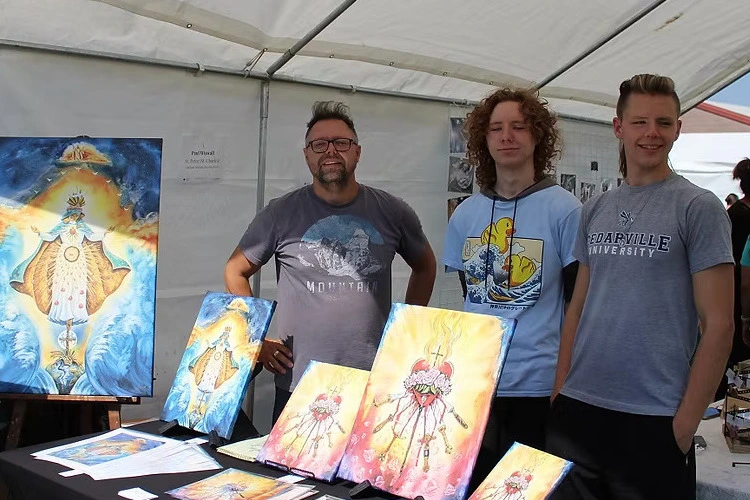
Later in life, I came back to the Church and I got asked by an old friend to do a painting for her recording studio of our Blessed Mother. And because of how connected to Mary I was at that time in my spiritual journey, I couldn’t help but say yes. I felt terrified, but I knew I would love to do it because it's of my mother. And that's all God needed from me. I spent a lot of time studying and researching, but probably more time just thinking and praying about how to make it. I wanted it to be something that has symbolism, numbers, colors and things that are of interest to me — things that I think are important in telling the story of Mary. And so, over the course of a Lent and some more time after that, I developed this particular Stella Maris, the Stella Tempesta Maris.
Later in life, I came back to the Church and I got asked by an old friend to do a painting for her recording studio of our Blessed Mother. And because of how connected to Mary I was at that time in my spiritual journey, I couldn’t help but say yes. I felt terrified, but I knew I would love to do it because it's of my mother. And that's all God needed from me. I spent a lot of time studying and researching, but probably more time just thinking and praying about how to make it. I wanted it to be something that has symbolism, numbers, colors and things that are of interest to me — things that I think are important in telling the story of Mary. And so, over the course of a Lent and some more time after that, I developed this particular Stella Maris, the Stella Tempesta Maris.
Q: What did your creative process look like?
Paul: I've worked for over 25 years in the print industry, so I know Photoshop like the back of my hand. But for the Stella Maris, I wanted to do something different with my hands. I was led to watercolor on canvas though I had only a little experience with it. Watercolor is an amazing medium to use because it has a mind of its own. Oil, acrylics, they do what you tell them. With watercolor, when you put it on the paper or canvas, it changes into something different as it dries.
This allowed for me to be praying and be like, 'Okay, God, I think this', and then give it time and let God draw it out. Let Him move the color and shift it and arrange it and do various things with it. And then I'd look at it and be like, 'Yeah, God, that worked.' Or, 'I don't know about that one. Let's try it this way.’ And He works with that. At one point in working on the Stella Maris, I had an idea for a method that I had discovered on a practice painting. And within like 20 or 30 minutes, the thing I was trying to do had happened. I had to sit down because I was shaking from amazement, and the adrenaline, maybe. It was just such an experience!
This allowed for me to be praying and be like, 'Okay, God, I think this', and then give it time and let God draw it out. Let Him move the color and shift it and arrange it and do various things with it. And then I'd look at it and be like, 'Yeah, God, that worked.' Or, 'I don't know about that one. Let's try it this way.’ And He works with that. At one point in working on the Stella Maris, I had an idea for a method that I had discovered on a practice painting. And within like 20 or 30 minutes, the thing I was trying to do had happened. I had to sit down because I was shaking from amazement, and the adrenaline, maybe. It was just such an experience!
Q: Wow! That's amazing! How often does something like that happen?
Paul: That certainly doesn't happen all the time. But in each of the four paintings I've done, I experienced God meeting me in prayer, shaping my imagination, guiding me, and then the two of us working together to make them. Not that the end result was so holy, but He was involved in the process. And really, through all this I learned that this is how all of life should be.
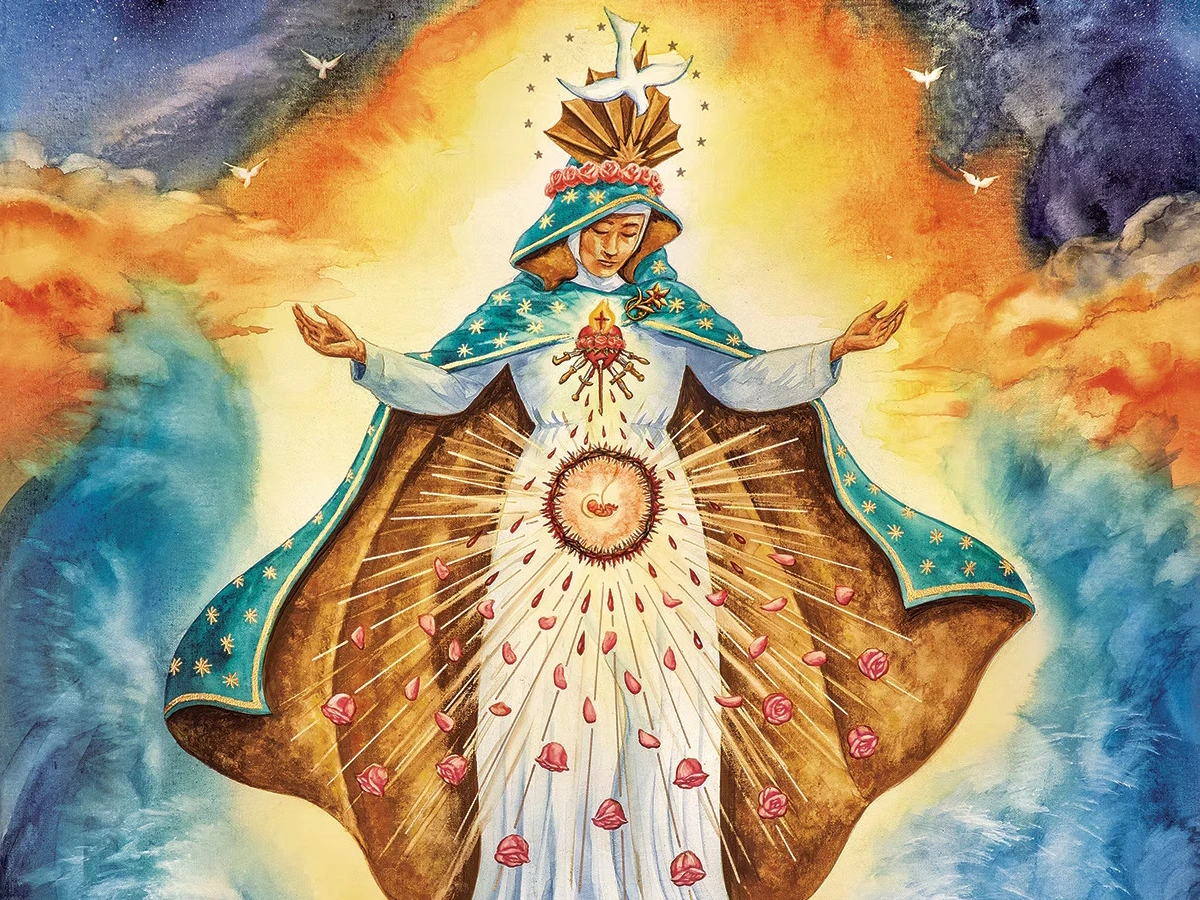
A great example of this is with Mary's head covering in the Stella Maris. I spent weeks trying to draw her with a veil, but kept drawing a cloak instead. I couldn't even draw a simple veil! I got a little frustrated and prayed, 'Why do I keep doing it this way and I can't get away from it?’ During that same time I was also praying, 'God, how do I depict the Visitation? And traveling to Egypt? And everywhere else without making this into a collage?’ Oh! A cloak represents a traveler! So God kept putting it in my head, but it took prayer to see it. That's just one of the ways He works with us.
A great example of this is with Mary's head covering in the Stella Maris. I spent weeks trying to draw her with a veil, but kept drawing a cloak instead. I couldn't even draw a simple veil! I got a little frustrated and prayed, 'Why do I keep doing it this way and I can't get away from it?’ During that same time I was also praying, 'God, how do I depict the Visitation? And traveling to Egypt? And everywhere else without making this into a collage?’ Oh! A cloak represents a traveler! So God kept putting it in my head, but it took prayer to see it. That's just one of the ways He works with us.
Q: Really!?! You've only painted four things?
Paul: Kind of. I had to do paintings to get through college, but I didn't like them. I prefer dry mediums. I’ve painted these four pieces of devotional art that I'm pleased with. I didn't set out to paint them or to make money on them. It isn't my career. It's a thing I do on the side, a way I get to share God with people. So that's all I've made so far. But I let God make the talent become present in the way that He wants it to.
I've designed one of Joseph to be a companion with the Stella Maris. I had started putting it on canvas, and then just enough things in life happened where I had to put it off. Whether it's me being too anxious or worried, or kids getting married and various things. I make sure to put family before this stuff because God has a time for it. And when the time's right, He'll present it, and I won't be so terrified. I'll be able to say, 'God, let's do it!'
I've designed one of Joseph to be a companion with the Stella Maris. I had started putting it on canvas, and then just enough things in life happened where I had to put it off. Whether it's me being too anxious or worried, or kids getting married and various things. I make sure to put family before this stuff because God has a time for it. And when the time's right, He'll present it, and I won't be so terrified. I'll be able to say, 'God, let's do it!'
Q: You often give away descriptions that go along with your painting. How did that come about?
Paul: Well, first let me say that I mostly agree with artists who say art should personally speak to a viewer and a description ruins an aspect of that. I'm excited if someone sees my art and they can connect and let God communicate through it without a description. That's ideal.
But people look at my art and ask, 'Well, why did you do that specifically?' I have lots of symbolism, and numbers, and things that are very intentional. Like, Christ coming from the monstrance of Mary's womb. And that's surrounded by the crown of thorns. And then there are intentionally three streams of blood, and there's a certain amount of blood droplets, and then there's a certain number of petals. And the blood turns into petals which turn into roses, and that's meant to represent the suffering that blooms into sainthood. There are twelve roses at the bottom, utilizing the apostles to signify sainthood, because through Christ we're being made into saints. Counting the number of droplets, petals, flowers, and adding to the number of the three streams, it all adds up to 144, which is a reference to the Holy Church in the Book of Revelation.
Truthfully, I write a description so that I can remember, and if others want to know, then here’s a copy. But also, knowing how people look at a painting of Leonardo da Vinci, for example, and read into it things he may not have intended, then there’s a detailed explanation for clarity in the future. I’m just kind of a geek that way.
But people look at my art and ask, 'Well, why did you do that specifically?' I have lots of symbolism, and numbers, and things that are very intentional. Like, Christ coming from the monstrance of Mary's womb. And that's surrounded by the crown of thorns. And then there are intentionally three streams of blood, and there's a certain amount of blood droplets, and then there's a certain number of petals. And the blood turns into petals which turn into roses, and that's meant to represent the suffering that blooms into sainthood. There are twelve roses at the bottom, utilizing the apostles to signify sainthood, because through Christ we're being made into saints. Counting the number of droplets, petals, flowers, and adding to the number of the three streams, it all adds up to 144, which is a reference to the Holy Church in the Book of Revelation.
Truthfully, I write a description so that I can remember, and if others want to know, then here’s a copy. But also, knowing how people look at a painting of Leonardo da Vinci, for example, and read into it things he may not have intended, then there’s a detailed explanation for clarity in the future. I’m just kind of a geek that way.
Q: You recently did a digital art restoration of the Stations of the Cross. How did that work?
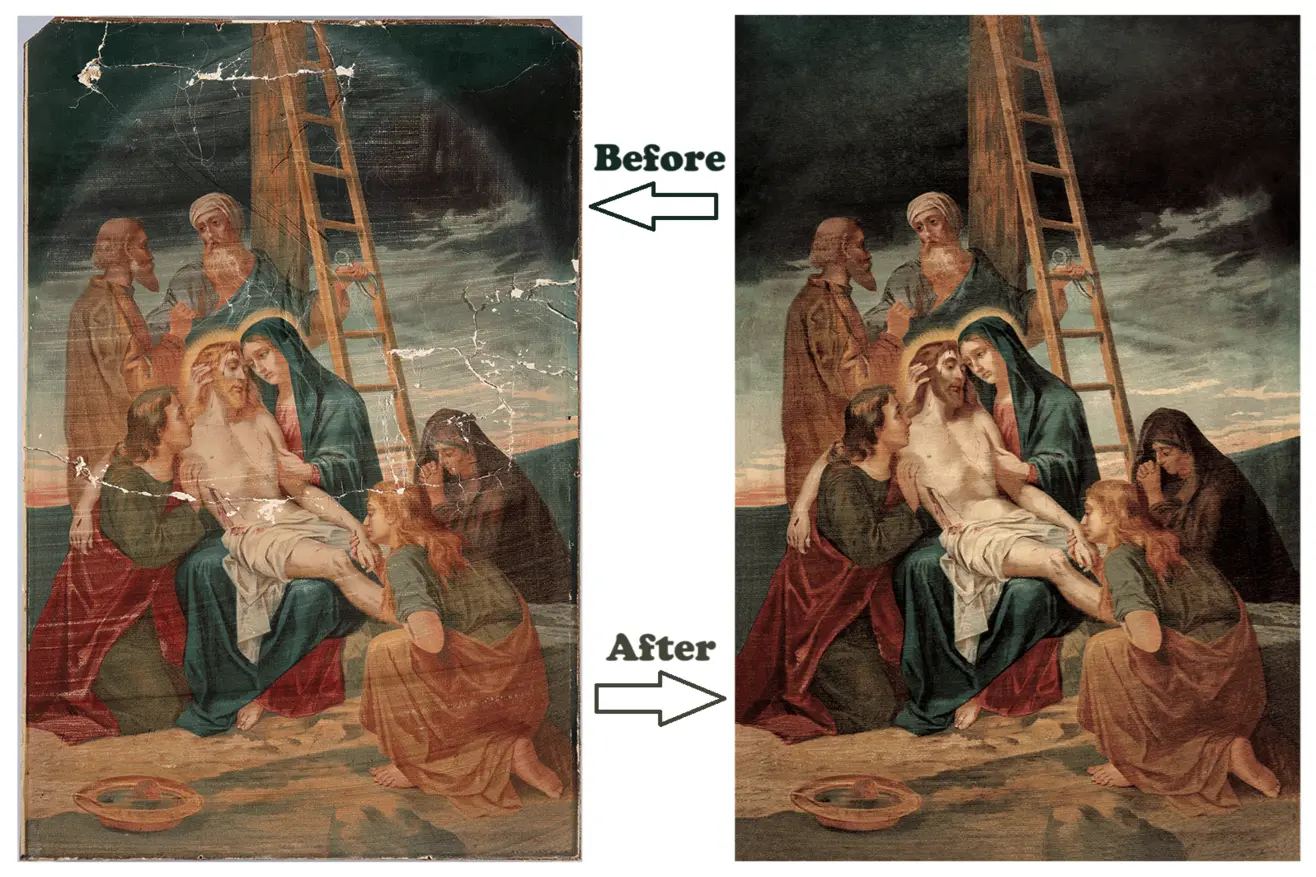
Paul: My parish, St. Elizabeth Ann Seton, was replacing their Stations of the Cross with a set they found online that they thought were very beautiful - very traditional and classical looking with canvas paintings inside wooden frames. But they arrived in a lot worse condition than expected. They had swipe marks from cleaning, they were faded, and some were torn. One of them looked almost punched through because of how much tearing had happened, but not like somebody tried to desecrate them. I wanted to help repair them, but I knew my wife and I had a lot going on and I didn't want to stress her out, because she's the heart of the family. So I shared this with her, and she was like, 'You should go do that.'
So after Mass the next Sunday, I spoke with Father Vordtriede about helping to restore the paintings. It turned out, they weren’t paintings but prints on old canvases, so I knew exactly what to do. I had them photographed and cleaned them up in Photoshop. At my work, we have a machine that prints on canvases, so I just reprinted them on new canvases and rewrapped them, like I do with my own reproductions. We were very happy with the end result. It's a great sense of traditional imagery that really draws you in more. We're tactile creatures, so we need that beauty to catch the tiniest glimpses of the Beatific Vision and remind us it's there.
So after Mass the next Sunday, I spoke with Father Vordtriede about helping to restore the paintings. It turned out, they weren’t paintings but prints on old canvases, so I knew exactly what to do. I had them photographed and cleaned them up in Photoshop. At my work, we have a machine that prints on canvases, so I just reprinted them on new canvases and rewrapped them, like I do with my own reproductions. We were very happy with the end result. It's a great sense of traditional imagery that really draws you in more. We're tactile creatures, so we need that beauty to catch the tiniest glimpses of the Beatific Vision and remind us it's there.
What advice do you have for aspiring artists?
Paul: Recognize that your talents are a part of who you are, and your deficiencies are a part of who you are. Open both of those up to God, because He's in both. He gives us the deficiency so that we will reach out to Him. And when we do that, it elevates our talents.
I always like to point at Charles Dickens' A Christmas Carol. I know it's really hard to understand, but when people think of their own shortcomings in life or of a person with a disability, that's God loving you. Look at A Christmas Carol. The two most obviously loved characters in that story are Scrooge, who's deficient in his ability to recognize love, and Tiny Tim, who's the hero of the whole piece even though he's crippled. And it's so clear that Dickens loves Tiny Tim! He wrote him that way! His disability wasn't a problem! It's a deficiency, but it's in that that Tiny Tim finds God. He sees God, and then he becomes an example of God to others around him. And it's through that deficiency that he saves Scrooge.
So don't be afraid to give it all to God. This is what the purpose of the artist is. It's not simply to make a pretty picture. It's to signify to everyone else in the world that when you allow God to work through the talents He gave you, it'll produce something that's beautiful because He'll elevate it if you allow Him to be present with you. I've tried that process with life, and seen the same result. It's terrifying and uncomfortable when you enter into a challenging situation, right? But in the end He elevates it and makes it beautiful.
I always like to point at Charles Dickens' A Christmas Carol. I know it's really hard to understand, but when people think of their own shortcomings in life or of a person with a disability, that's God loving you. Look at A Christmas Carol. The two most obviously loved characters in that story are Scrooge, who's deficient in his ability to recognize love, and Tiny Tim, who's the hero of the whole piece even though he's crippled. And it's so clear that Dickens loves Tiny Tim! He wrote him that way! His disability wasn't a problem! It's a deficiency, but it's in that that Tiny Tim finds God. He sees God, and then he becomes an example of God to others around him. And it's through that deficiency that he saves Scrooge.
So don't be afraid to give it all to God. This is what the purpose of the artist is. It's not simply to make a pretty picture. It's to signify to everyone else in the world that when you allow God to work through the talents He gave you, it'll produce something that's beautiful because He'll elevate it if you allow Him to be present with you. I've tried that process with life, and seen the same result. It's terrifying and uncomfortable when you enter into a challenging situation, right? But in the end He elevates it and makes it beautiful.
Paul’s devotional art is available for purchase at Veils by Lily at 403 Oak Street, Imperial, MO and online at his website, wildgoosedesigns.com
Additional Links
- Paul's website: wildgoosedesigns.com
- Paul's CAN Artist Profile
- Veils by Lily